
 Omnigent
The open-source meta-harness for all your AI agents.
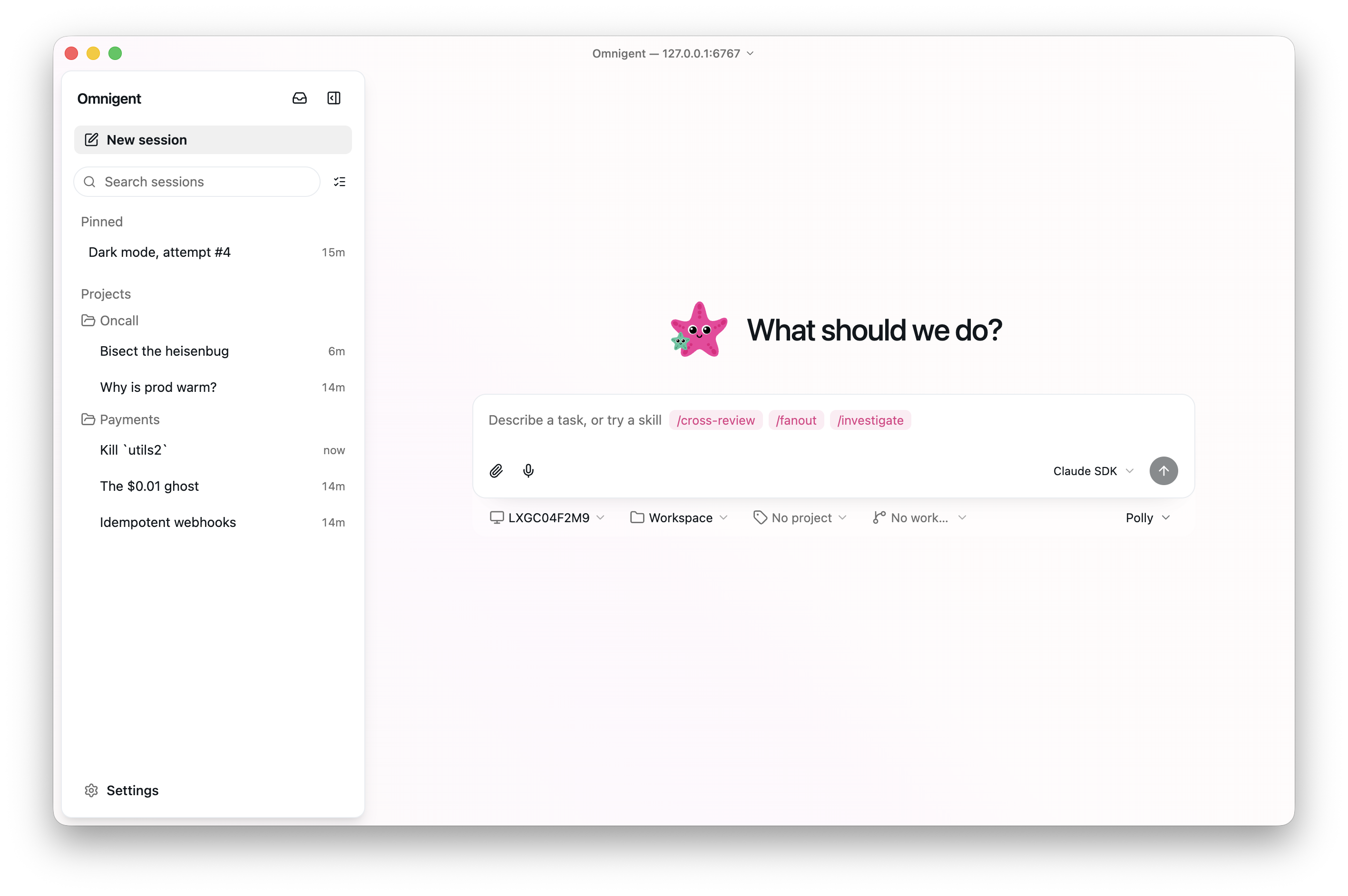
Omnigent is an open-source meta-harness that gives you a common orchestration layer over Claude Code, Codex, Cursor, OpenCode, Hermes, Pi, and the agents you write yourself: swap or combine harnesses without rewriting, enforce policies and sandboxing, and collaborate in real time from any device — terminal, browser, phone, or the native desktop app.




Why Omnigent?
Omnigent lets you:
-
📱 Work with agents from any device, including your phone. Sessions follow you: start in your terminal, continue in the browser, pick it up on your phone. Messages, sub-agents, terminals, and files stay in sync.
-
🤖 Supervise multiple agents. Mix Claude Code, Codex, Cursor, OpenCode, Hermes, Pi, and custom agents (defined in YAML) together in the same session. Ask one agent to review another's work, or split a task across agents that are each good at different things.
-
🔌 Use any model. A first-party API key, a Claude/ChatGPT subscription, or any compatible gateway. All first-class.
-
🤝 Collaborate. Share a session so teammates can chat with your agent and watch it work live, co-drive it on your machine, or fork the conversation to continue on their own.
-
☁️ Run agents in cloud sandboxes. No laptop required: run sessions in disposable Modal, Daytona, Blaxel, Islo, E2B, Gensee, CoreWeave, Kubernetes, OpenShell, Boxlite, microsandbox, or Databricks sandboxes, launched from the CLI or provisioned by the server per session (managed hosts).
-
🛡️ Govern your agents. Create policies to pause for your approval before risky actions, cap spend, or limit which tools an agent reaches. They apply to the whole server, one agent, or a single chat.
Quick start
1. Install
One command installs Omnigent and everything it needs:
curl -fsSL https://raw.githubusercontent.com/omnigent-ai/omnigent/main/scripts/install_oss.sh | shOptional integrations and extras
Need an optional integration? Pass one or more extras to the installer:
curl -fsSL https://raw.githubusercontent.com/omnigent-ai/omnigent/main/scripts/install_oss.sh | sh -s -- --extra databricks
curl -fsSL https://raw.githubusercontent.com/omnigent-ai/omnigent/main/scripts/install_oss.sh | sh -s -- --extra modal,e2b
Available user-facing extras include:
- Model providers:
databricks,bedrock,vertex - Sandbox providers:
modal,daytona,blaxel,boxlite,microsandbox,cwsandbox,e2b,openshell,kubernetes - SDK harnesses:
antigravity,copilot,cursor,agents-sdk - Storage and memory:
s3,hindsight
Prefer to install manually?
Omnigent needs Python 3.12+. Install the omnigent package:
uv tool install omnigent # or: pip install "omnigent"Manual installs use the same extras syntax, for example:
uv tool install "omnigent[databricks,modal]"Or with Homebrew:
brew install omnigent-ai/tap/omnigentFor source builds on networks that require package mirrors, replace these example URLs with your mirrors:
HOMEBREW_PIP_INDEX_URL='https://pypi.example.com/simple' \
HOMEBREW_CARGO_INDEX_URL='https://cargo.example.com/index/' \
  brew install --build-from-source omnigent-ai/tap/omnigent
The PyPI setting also routes pip's isolated build dependencies through the mirror.
The Cargo setting takes a sparse registry index URL ending in /, without the
sparse+ prefix. Both overrides are optional and do not affect prebuilt-bottle
installs.
Or install straight from the repo:
uv tool install -q --python 3.12 git+https://github.com/omnigent-ai/omnigent.gitToolchain and prerequisites (if the installer reports a missing tool)
uv(required). https://docs.astral.sh/uv/getting-started/installation/ The installer offers to set this up for you.git(required).- Node.js 22 LTS or newer with
npm(for the coding-harness CLIs installed byomnigent run) andpnpm(for the web UI). You can get both from a single Node install; pnpm is available viacorepack enableornpm install -g pnpm. - Devin CLI (optional), for
omnigent devin: install withcurl -fsSL https://cli.devin.ai/install.sh | bash, then sign in withdevin auth login. Devin tool approvals appear as Chat approval cards (itsPermissionRequesthook is mirrored to the web UI) and stay answerable in the embedded Terminal. Seedocs/devin-native.md. - Kiro CLI (optional), for
omnigent kiro: install withcurl -fsSL https://cli.kiro.dev/install | bash, then sign in with Kiro. Kiro tool approvals stay answerable in the embedded Terminal; supported one-time approvals also appear as Chat cards. Seedocs/kiro-native-elicitation.md. tmux, required by the nativeomnigent <harness>terminal wrappers (claude,codex,cursor,devin,hermes,kiro,pi) (brew install tmux/apt install tmux; the installer offers to install it for you).bubblewrap(bwrap), Linux only. The nativeomnigent <harness>terminal wrappers and thepiharness wrap each agent terminal in abwrapOS-sandbox; on Linux that isolation is mandatory, so a missingbwrapbinary makes those terminals fail to start (apt install bubblewrap; the installer offers to install it for you). macOS uses the built-inseatbeltsandbox and needs nothing extra.- Databricks (optional). To use a Databricks workspace as your model
provider, install Omnigent with the
databricksextra:uv tool install "omnigent[databricks]"— or pass it to the bootstrap installer with... | sh -s -- --extra databricks. Signing in to the workspace also uses the Databricks CLI.
Windows (native)
Omnigent runs natively on Windows in a degraded mode. The install_oss.sh
bootstrap is POSIX-only, so install with uv directly:
uv tool install --python 3.12 omnigent
# or from the repo:
uv tool install --python 3.12 git+https://github.com/omnigent-ai/omnigent.git
What works on Windows: omnigent server, the web UI, and the SDK-based
harnesses (omnigent run <agent.yaml> with the claude-sdk / cursor / codex
harnesses). Agents run under a Windows Job Object for process-tree
containment.
What is not available on Windows (use Linux/macOS, or WSL, for these):
- the native
omnigent claude/omnigent codex/omnigent cursortmux/PTY terminal wrappers (run an SDK harness or the web UI instead); bwrap/seatbeltfilesystem & network sandboxing and the L7 egress proxy — the Job Object backend contains the process tree and enforces resource limits but does not isolate the filesystem or network.
Updating to a new release
When a newer release is on PyPI, Omnigent shows a one-line notice (once per release) pointing here. To update:
omni upgrade            # detects how you installed, drains & stops the local
                        # server, then runs the matching upgrade command
omni upgrade --check    # just report whether a newer release is available
omni upgrade waits for in-flight agent sessions to finish before stopping the
local server (pass --force to stop them immediately); the next omni command
brings the server back up on the new version. Source checkouts update with
git pull instead. Silence the notice with OMNIGENT_NO_UPDATE_CHECK=1.
The check queries your configured package index — honoring UV_INDEX_URL /
PIP_INDEX_URL and your uv.toml / pip.conf (default PyPI), so private
mirrors work out of the box; override with OMNIGENT_INDEX_URL if needed.
Uninstalling Omnigent
Preview the CLI/profile cleanup that would run by default:
omnigent uninstallRemove the CLI and installer-managed PATH entries while keeping your local history, credentials, and projects:
omnigent uninstall --yesTo also remove Omnigent state under ~/.omnigent, pass --purge; Omnigent
backs it up outside the target before deletion. Your ~/omnigent workspace is
kept unless you explicitly add --purge-workspace.
omnigent uninstall --purge --yesIf the installed wheel is broken or omnigent is not on PATH, run the
standalone script instead:
curl -fsSL https://raw.githubusercontent.com/omnigent-ai/omnigent/main/scripts/uninstall_oss.sh | shAdd --yes to the standalone script to perform the previewed CLI cleanup.
2. Start your first agent
omnigent picks a model with you and starts a session in your terminal. It
also launches a local web UI at http://localhost:6767 that shows the same
session in the browser, or on a phone on your network (step 4). The
desktop app wraps that same UI
in a native window and adds OS notifications (with a configurable sound) and a dock badge —
download it for macOS.
Note
The install puts two names for the same CLI on your PATH: omnigent and
the shorter omni. They're interchangeable.
Tip
On first run, Omnigent picks up model credentials already in your
environment (an ANTHROPIC_API_KEY / OPENAI_API_KEY, or a claude /
codex CLI you're logged into) and offers one as the default.
omnigentOr launch a specific agent runtime:
omnigent claude                      # Claude Code, in a session your team can join
omnigent codex                       # Codex
omnigent cursor                      # Cursor
omnigent agy                         # Antigravity
omnigent opencode                    # OpenCode
omnigent hermes                      # Hermes Agent (Nous Research)
omnigent pi                          # Pi
omnigent agy requires agy 1.1.13 or newer. When GEMINI_API_KEY is set,
direct Gemini API authentication takes precedence over agy's saved OAuth login.
Using OpenClaw? See the OpenClaw integration guide to import its coding agents or drive a live OpenClaw Gateway session over ACP.
Grok Build and Devin
Two more coding agents are built in but have no omnigent <name> launcher of
their own, because each ships a CLI that holds its own login. Install the vendor
CLI, log in with it, then name the harness:
# Grok Build (xAI)
curl -fsSL https://x.ai/cli/install.sh | bash
grok login --device-auth              # xAI OAuth
omnigent run --harness grok           # 'grok-build' also works

# Devin (Cognition)
curl -fsSL https://cli.devin.ai/install.sh | bash
devin auth login
omnigent run --harness devin
Both speak the Agent Client Protocol over
stdio, and Omnigent stores no credential for either — each CLI reads back the
login it wrote to disk. That also means --model is refused rather than
silently dropped: both run their account-default model. To pin one, configure an
acp: agent whose command passes the vendor's own model flag.
Use the vendor login rather than an API key. A builtin ACP row has no
env_passthrough of its own, and XAI_API_KEY is not in the host-to-runner
credential allowlist, so exporting it in your shell does not reach the agent.
If you need the key route, pass it explicitly with
OMNIGENT_RUNNER_ENV_PASSTHROUGH=XAI_API_KEY, or configure an acp: agent that
declares the passthrough.
🐙 Polly and 🟠🔵 Debby
Two example agents ship with the repo, and they make good first sessions:
omnigent run examples/polly/
omnigent run examples/debby/
omnigent run examples/deep-research/

# ...or on a different harness (sub-agents keep their own):
omnigent run examples/polly/ --harness <harness>
omnigent run examples/debby/ --harness <harness>
🐙 Polly is a multi-agent coding orchestrator who writes no code herself. She's the tech lead: she plans, delegates the work to coding sub-agents (Claude Code, Codex, or Pi) in parallel git worktrees, then routes each diff to a reviewer from a different vendor than the one that wrote it. You merge.
🟠🔵 Debby is a brainstorming partner with two heads, one Claude and one GPT.
Every question you ask goes to both heads, and she lays the two answers out
side by side. Type /debate and the heads critique each other for a few
rounds before converging. (She needs both a Claude and an OpenAI credential;
see step 3.)
🔎 Deep Research is a single agent that answers a question with a cited,
cross-checked report. It plans sub-queries, searches the live web and reads
full pages through an MCP search server, and verifies each claim across
independent sources. It's also the simplest example to copy from: one agent
plus one tools/mcp/*.yaml server, no sub-agents.
Prefer the browser? One command starts the local server and registers this machine as a host:
omnigent start # starts the local server and registers this machine as a hostOpen the server URL it prints, hit New Chat, pick your machine, and go.
Check status with omnigent server status; stop everything with
omnigent stop.
To suppress the automatic browser tab, use omni host --no-open or set
OMNIGENT_HOST_NO_OPEN=1 in your shell. Both also apply to omni host --background and omni start. Sign-in may still open a browser; use
--non-interactive in scripts to fail if sign-in is required.
Customize automatic session titles
Set additional natural-language requirements for the isolated title generator:
omnigent config set --global \
  'session_title_instructions=Prefix titles with the current date as lowercase mon-dd. Use PR-number-short-name for pull requests, issue-number-short-description for issues, and a short snake_case activity otherwise.'
The title generator receives the current date as YYYY-MM-DD, then applies
these requirements to the first user message. The setting is server-owned and
does not alter an agent's portable instructions. Default generated titles are
limited to 100 characters; custom title requirements may use up to 200.
Default titles over 100 characters are rejected, leaving the first-message
fallback title in place. Custom titles over 200 characters are truncated with
a trailing ellipsis. Manually assigned titles are also limited to 200
characters. The setting applies after the local Omnigent server restarts, both
to new sessions and to later agent-initiated renames through sys_session_rename.
Agent proposals are formatted using the same title requirements; if formatting
fails, the existing title is preserved. Manual renames remain unchanged.
For longer instructions, edit ~/.omnigent/config.yaml directly and use a YAML
block scalar:
session_title_instructions: |
  Prefix every title with the current date as lowercase mon-dd.
  For pull requests use mon-dd-PR-number-short-name.
  For issues use mon-dd-issue-number-short-description.
  For other work use mon-dd-short_snake_case_activity.
Server operators can set the same key in the YAML passed to
omnigent server --config.
3. Choose & switch models
omnigent setupAdd a credential, set a default, or remove one, grouped by agent. Omnigent works with four kinds of credentials:
| Kind | What it is | |
|---|---|---|
| 🔑 | API key | A first-party vendor key for Anthropic, OpenAI, and similar providers |
| 🎟️ | Subscription | A Claude Pro/Max or ChatGPT plan, via the official claude / codex CLIs |
| 🌐 | Gateway | Any OpenAI- or Anthropic-compatible base_url and key (OpenRouter, LiteLLM, Ollama, vLLM, Azure) |
| 🧱 | Databricks | A Databricks workspace profile (requires the databricks extra) |
Defaults are per agent, so a Claude default and a Codex default coexist. You
can also switch models in the middle of a session with the /model command.
Gateway base URLs (OpenRouter, Ollama)
When you add a Gateway credential, omnigent setup asks for a base URL
and a key. The base URL depends on which agent you point it at:
| Provider | For | Base URL | Key |
|---|---|---|---|
| OpenRouter | Claude Code | https://openrouter.ai/api |
your OpenRouter key (sk-or-…) |
| OpenRouter | Codex / OpenAI agents | https://openrouter.ai/api/v1 |
your OpenRouter key (sk-or-…) |
| Ollama (local) | Codex / OpenAI agents | http://localhost:11434/v1 |
any value (Ollama ignores it) |
For Claude Code, point at OpenRouter's Anthropic-compatible endpoint
(…/api, not …/api/v1). For Codex and the OpenAI-agents harness, use
the OpenAI-compatible …/api/v1.
4. Deploy a server (and use it from your phone📱)
Run Omnigent on a server with a stable URL
(deploy/README.md is the full guide) and your sessions
become reachable from anywhere, including your phone. The web UI is built for
mobile, so you get the same chat, sub-agents, terminals, and files, in sync
with your laptop.
One docker compose up runs the server on any host you have (a VPS, a home
server); Render and Railway deploy with one click; Fly.io, Hugging
Face Spaces, Modal, Cloudflare (serverless, scale-to-zero), and
Databricks Apps (backed by Lakebase Postgres and Unity Catalog Volumes) are
covered too — and a Cloudflare quick tunnel (public) or Tailscale
(private) reaches a server running on your own laptop without a deploy. The
server can also provision a cloud sandbox per session (managed hosts), so no
laptop has to stay online. The full menu of targets, the database options, the
sandbox setup, and
branding/white-labeling
live in
deploy/README.md.
Once the server is up, sign in and register your laptop as a host:
omnigent login https://your-host    # sign in once; run / attach / host reuse the token
omnigent host  https://your-host    # new sessions can now run on this machine
Tip
On your own network you don't need a deploy. Open your machine's LAN
address on your phone (e.g. http://192.168.x.x:6767).
5. Collaborate with your team
Omnigent supports multi-user accounts, controlled by one environment variable:
OMNIGENT_AUTH_ENABLED=1 omnigent server --backgroundThe Docker deploy in step 4
turns it on for you (OMNIGENT_AUTH_ENABLED defaults to 1 there).
Invite your teammates
Open the web UI (http://localhost:6767 locally, or your host's URL) and
sign in as admin; first run prints the password and saves it locally. Then
open Admin → Members → Invite to create a single-use invite link, no
email server needed. Send it over; your teammate opens it, sets a password,
and they're in. Signup is invite-only.
Note
Teammates need to be able to reach the server. A local server is only reachable on your network; for anyone off it, deploy an always-on host (see step 4).
Code together
-
Share a live session. Hit Share in the web UI and send the link; teammates watch your agent work and chat with it in real time.
-
Leave a shared session. Done with a session someone shared with you? Pick Leave session from its sidebar row menu to drop it from your sidebar. Nothing is deleted — the owner keeps it and can share it again.
-
Co-drive. A teammate co-attaches to your running session; their messages execute on your machine. Great for pairing or handing the keyboard to a domain expert mid-investigation.
omnigent attach <session_id>
-
Fork. Clone a conversation onto your own machine and continue independently from the fork point.
omnigent run --fork <session_id>
Tip
Want your team to sign in with the logins they already have (Google,
GitHub, Okta, Microsoft)? Set OMNIGENT_OIDC_ISSUER plus a client ID
and secret on your deployed server and restart. The full walkthrough,
domain allowlists, and the proxy-only header auth mode are covered in
deploy/README.md#auth.
6. Govern your agents with policies
Policies decide what an agent may do: run shell commands, edit files, spend tokens. They check every action and either allow it, block it, or pause to ask you first.
- In the web UI: open a session's info panel to browse the available policies and toggle them on or off.
- In chat: ask. "Add a policy that asks me before running shell commands." The agent sets it up for you.
Want defaults that apply to everyone, or to a specific agent? Define them in your server config or an agent's YAML:
policies:
  approve_shell:
    type: function
    handler: omnigent.policies.builtins.safety.ask_on_os_tools   # ask before shell / file writes
  cap_calls:
    type: function
    handler: omnigent.policies.builtins.safety.max_tool_calls_per_session
    factory_params:
      limit: 50                    # cap how many tools one session can call
  budget:
    type: function
    handler: omnigent.policies.builtins.cost.cost_budget
    factory_params:
      max_cost_usd: 5.00           # hard spend cap...
      ask_thresholds_usd: [3.00]   # ...with a soft warning on the way
Policies stack across three levels, server-wide (admin), per-agent (developer), and per-session (you), with the stricter session rules checked first. Spend caps and access limits ship as builtins.
See the policy guide for the full catalog and trust model.
Write your own agent
An agent is a short YAML file: your prompt, your tools — local Python functions, MCP servers, and sub-agents a supervisor can delegate to. You don't have to write it by hand: agents can build agents, so describe the agent you want in any Omnigent chat and it authors the file for you.
name: my_agent
prompt: You are a helpful data analyst.

executor:
  harness: claude-sdk          # or: claude-native, codex, codex-native, cursor,
                               # cursor-native, hermes, hermes-native, opencode,
                               # pi, pi-native, openai-agents

tools:
  # A local Python function (schema auto-generated from the signature)
  word_count:
    type: function
    callable: mypackage.mymodule.word_count

  # Tools from an MCP server (a local command, or a remote URL)
  docs:
    type: mcp
    url: https://example.com/mcp

  # A sub-agent the supervisor can delegate to
  researcher:
    type: agent
    prompt: Search for relevant information and summarize it.
    tools:
      word_count: inherit
Run it with:
omnigent run path/to/my_agent.yamlThe same file can declare sub-agents and reviewers. For a fuller example, see
Polly at examples/polly/, and the
Agent YAML spec for the full schema.
Telemetry
Omnigent collects anonymized usage data (telemetry) by default. This data contains no sensitive or personally identifiable information. If you're using Omnigent through a managed service or distribution, please consult your managed service agreement to determine any data collection that may impact your use of the service. To opt out, follow our instructions in Usage Telemetry.
Contributing
Contributions are welcome. See CONTRIBUTING.md for how to set up your environment, run the checks, and open a pull request.
Adding or changing support for a harness (Claude, Codex, Cursor, OpenCode, Hermes, Pi, ...)? Run the harness test bench to check its capability matrix against observed behavior.
Contributors
Thanks to all of our amazing contributors!


