paperclipai/paperclipPublic

The open-source app everyone uses to manage agents at work

AI summary: A lightweight AI agent designed to operate specifically within codebases and browser environments.

Stars
97.1K
+362 today
Forks
16.4K
Watchers
461
Open issues
2.7K
Open PRs
3.6K
Contributors
~218
Commits
4.7K
Branches
1K

TypeScriptMITCreated Mar 2, 2026Last push todayLatest release v2026.1001.0+7.3K stars this week+17.1K this month

Quick answers

What is paperclip?
A lightweight AI agent designed to operate specifically within codebases and browser environments.
What does paperclip do?
Paperclip is an intelligent, developer-focused AI assistant that integrates tightly with codebases and browser environments to automate repetitive development tasks. It analyzes local repository structures, reads and modifies code, and interfaces with web browsers to perform testing and research operations directly. By bridging the gap between local development environments and web-based resources, it enables developers to seamlessly transition between writing code and gathering external context without context switching. The project aims to simplify workflows by providing a versatile, locally running agent capable of multi-step reasoning.
Who is paperclip for?
Software engineers and developers seeking an integrated AI assistant capable of interacting with both their local codebase and the web.
How do I get started with paperclip?
Install via npm using `npm install -g paperclip-agent` and start it in your project directory.
How popular is paperclip on GitHub?
paperclipai/paperclip has 97,087 stars and 16,427 forks on GitHub, and gained 7,337 stars in the last 7 days.
What license does paperclip use?
paperclipai/paperclip is released under the MIT license.

Star history

since Jul 29, 2026
025K50K75KJul 2026Aug 2026Sep 2026Oct 2026
97.1K stars as of Oct 4, 2026. Measured daily since Jul 29, 2026; GitHub no longer exposes earlier star timestamps.

Contribution activity

commits per day, last 52 weeks
OctNovDecJanFebMarAprMayJunJulAugSepMonWedFri2025-10-04: 0 commits2025-10-05: 0 commits2025-10-06: 0 commits2025-10-07: 0 commits2025-10-08: 0 commits2025-10-09: 0 commits2025-10-10: 0 commits2025-10-11: 0 commits2025-10-12: 0 commits2025-10-13: 0 commits2025-10-14: 0 commits2025-10-15: 0 commits2025-10-16: 0 commits2025-10-17: 0 commits2025-10-18: 0 commits2025-10-19: 0 commits2025-10-20: 0 commits2025-10-21: 0 commits2025-10-22: 0 commits2025-10-23: 0 commits2025-10-24: 0 commits2025-10-25: 0 commits2025-10-26: 0 commits2025-10-27: 0 commits2025-10-28: 0 commits2025-10-29: 0 commits2025-10-30: 0 commits2025-10-31: 0 commits2025-11-01: 0 commits2025-11-02: 0 commits2025-11-03: 0 commits2025-11-04: 0 commits2025-11-05: 0 commits2025-11-06: 0 commits2025-11-07: 0 commits2025-11-09: 0 commits2025-11-10: 0 commits2025-11-11: 0 commits2025-11-12: 0 commits2025-11-13: 0 commits2025-11-14: 0 commits2025-11-15: 0 commits2025-11-16: 0 commits2025-11-17: 0 commits2025-11-18: 0 commits2025-11-19: 0 commits2025-11-20: 0 commits2025-11-21: 0 commits2025-11-22: 0 commits2025-11-23: 0 commits2025-11-24: 0 commits2025-11-25: 0 commits2025-11-26: 0 commits2025-11-27: 0 commits2025-11-28: 0 commits2025-11-29: 0 commits2025-11-30: 0 commits2025-12-01: 0 commits2025-12-02: 0 commits2025-12-03: 0 commits2025-12-04: 0 commits2025-12-05: 0 commits2025-12-06: 0 commits2025-12-07: 0 commits2025-12-08: 0 commits2025-12-09: 0 commits2025-12-10: 0 commits2025-12-11: 0 commits2025-12-12: 0 commits2025-12-13: 0 commits2025-12-14: 0 commits2025-12-15: 0 commits2025-12-16: 0 commits2025-12-17: 0 commits2025-12-18: 0 commits2025-12-19: 0 commits2025-12-20: 0 commits2025-12-21: 0 commits2025-12-22: 0 commits2025-12-23: 0 commits2025-12-24: 0 commits2025-12-25: 0 commits2025-12-26: 0 commits2025-12-27: 0 commits2025-12-28: 0 commits2025-12-29: 0 commits2025-12-30: 0 commits2025-12-31: 0 commits2026-01-01: 0 commits2026-01-02: 0 commits2026-01-03: 0 commits2026-01-04: 0 commits2026-01-05: 0 commits2026-01-06: 0 commits2026-01-07: 0 commits2026-01-08: 0 commits2026-01-09: 0 commits2026-01-10: 0 commits2026-01-11: 0 commits2026-01-12: 0 commits2026-01-13: 0 commits2026-01-14: 0 commits2026-01-15: 0 commits2026-01-16: 0 commits2026-01-17: 0 commits2026-01-18: 0 commits2026-01-19: 0 commits2026-01-20: 0 commits2026-01-21: 0 commits2026-01-22: 0 commits2026-01-23: 0 commits2026-01-24: 0 commits2026-01-25: 0 commits2026-01-26: 0 commits2026-01-27: 0 commits2026-01-28: 0 commits2026-01-29: 0 commits2026-01-30: 0 commits2026-01-31: 0 commits2026-02-01: 0 commits2026-02-02: 0 commits2026-02-03: 0 commits2026-02-04: 0 commits2026-02-05: 0 commits2026-02-06: 0 commits2026-02-07: 0 commits2026-02-08: 0 commits2026-02-09: 0 commits2026-02-10: 0 commits2026-02-11: 0 commits2026-02-12: 0 commits2026-02-13: 0 commits2026-02-14: 0 commits2026-02-15: 0 commits2026-02-16: 15 commits2026-02-17: 33 commits2026-02-18: 19 commits2026-02-19: 27 commits2026-02-20: 53 commits2026-02-21: 3 commits2026-02-22: 0 commits2026-02-23: 42 commits2026-02-24: 0 commits2026-02-25: 14 commits2026-02-26: 22 commits2026-02-27: 3 commits2026-02-28: 0 commits2026-03-01: 0 commits2026-03-02: 38 commits2026-03-03: 69 commits2026-03-04: 22 commits2026-03-05: 101 commits2026-03-06: 81 commits2026-03-07: 73 commits2026-03-08: 21 commits2026-03-09: 43 commits2026-03-10: 53 commits2026-03-11: 44 commits2026-03-12: 48 commits2026-03-13: 41 commits2026-03-14: 57 commits2026-03-15: 23 commits2026-03-16: 83 commits2026-03-17: 53 commits2026-03-18: 49 commits2026-03-19: 41 commits2026-03-20: 74 commits2026-03-21: 12 commits2026-03-22: 10 commits2026-03-23: 57 commits2026-03-24: 24 commits2026-03-25: 13 commits2026-03-26: 52 commits2026-03-27: 6 commits2026-03-28: 45 commits2026-03-29: 6 commits2026-03-30: 19 commits2026-03-31: 12 commits2026-04-01: 24 commits2026-04-02: 24 commits2026-04-03: 42 commits2026-04-04: 38 commits2026-04-05: 12 commits2026-04-06: 83 commits2026-04-07: 44 commits2026-04-08: 53 commits2026-04-09: 15 commits2026-04-10: 16 commits2026-04-11: 11 commits2026-04-12: 7 commits2026-04-13: 1 commit2026-04-14: 3 commits2026-04-15: 16 commits2026-04-16: 4 commits2026-04-17: 2 commits2026-04-18: 0 commits2026-04-19: 0 commits2026-04-20: 18 commits2026-04-21: 10 commits2026-04-22: 2 commits2026-04-23: 6 commits2026-04-24: 15 commits2026-04-25: 2 commits2026-04-26: 13 commits2026-04-27: 14 commits2026-04-28: 4 commits2026-04-29: 7 commits2026-04-30: 10 commits2026-05-01: 9 commits2026-05-02: 1 commit2026-05-03: 17 commits2026-05-04: 1 commit2026-05-05: 15 commits2026-05-06: 8 commits2026-05-07: 9 commits2026-05-08: 0 commits2026-05-09: 9 commits2026-05-10: 3 commits2026-05-11: 16 commits2026-05-12: 3 commits2026-05-13: 6 commits2026-05-14: 2 commits2026-05-15: 8 commits2026-05-16: 8 commits2026-05-17: 4 commits2026-05-18: 12 commits2026-05-19: 6 commits2026-05-20: 1 commit2026-05-21: 0 commits2026-05-22: 8 commits2026-05-23: 2 commits2026-05-24: 0 commits2026-05-25: 6 commits2026-05-26: 4 commits2026-05-27: 3 commits2026-05-28: 2 commits2026-05-29: 6 commits2026-05-30: 5 commits2026-05-31: 4 commits2026-06-01: 16 commits2026-06-02: 1 commit2026-06-03: 25 commits2026-06-04: 20 commits2026-06-05: 14 commits2026-06-06: 15 commits2026-06-07: 7 commits2026-06-08: 2 commits2026-06-09: 12 commits2026-06-10: 9 commits2026-06-11: 16 commits2026-06-12: 26 commits2026-06-13: 1 commit2026-06-14: 0 commits2026-06-15: 1 commit2026-06-16: 0 commits2026-06-17: 5 commits2026-06-18: 27 commits2026-06-19: 26 commits2026-06-20: 22 commits2026-06-21: 1 commit2026-06-22: 8 commits2026-06-23: 19 commits2026-06-24: 7 commits2026-06-25: 9 commits2026-06-26: 20 commits2026-06-27: 0 commits2026-06-28: 2 commits2026-06-29: 4 commits2026-06-30: 18 commits2026-07-01: 8 commits2026-07-02: 14 commits2026-07-03: 6 commits2026-07-04: 2 commits2026-07-05: 3 commits2026-07-06: 21 commits2026-07-07: 34 commits2026-07-08: 17 commits2026-07-09: 22 commits2026-07-10: 26 commits2026-07-11: 5 commits2026-07-12: 5 commits2026-07-13: 9 commits2026-07-14: 26 commits2026-07-15: 27 commits2026-07-16: 26 commits2026-07-17: 7 commits2026-07-18: 4 commits2026-07-19: 0 commits2026-07-20: 8 commits2026-07-21: 33 commits2026-07-22: 28 commits2026-07-23: 21 commits2026-07-24: 19 commits2026-07-25: 4 commits2026-07-26: 1 commit2026-07-27: 19 commits2026-07-28: 20 commits2026-07-29: 21 commits2026-07-30: 17 commits2026-07-31: 41 commits2026-08-01: 21 commits2026-08-02: 16 commits2026-08-03: 15 commits2026-08-04: 19 commits2026-08-05: 25 commits2026-08-06: 14 commits2026-08-07: 19 commits2026-08-08: 2 commits2026-08-09: 0 commits2026-08-10: 15 commits2026-08-11: 26 commits2026-08-12: 28 commits2026-08-13: 40 commits2026-08-14: 16 commits2026-08-15: 13 commits2026-08-16: 13 commits2026-08-17: 32 commits2026-08-18: 16 commits2026-08-19: 33 commits2026-08-20: 26 commits2026-08-21: 18 commits2026-08-22: 8 commits2026-08-23: 10 commits2026-08-24: 20 commits2026-08-25: 54 commits2026-08-26: 17 commits2026-08-27: 28 commits2026-08-28: 34 commits2026-08-29: 29 commits2026-08-30: 39 commits2026-08-31: 32 commits2026-09-01: 30 commits2026-09-02: 12 commits2026-09-03: 60 commits2026-09-04: 22 commits2026-09-05: 21 commits2026-09-06: 11 commits2026-09-07: 11 commits2026-09-08: 19 commits2026-09-09: 26 commits2026-09-10: 31 commits2026-09-11: 49 commits2026-09-12: 33 commits2026-09-13: 3 commits2026-09-14: 26 commits2026-09-15: 21 commits2026-09-16: 14 commits2026-09-17: 10 commits2026-09-18: 12 commits2026-09-19: 19 commits2026-09-20: 3 commits2026-09-21: 29 commits2026-09-22: 26 commits2026-09-23: 16 commits2026-09-24: 11 commits2026-09-25: 12 commits2026-09-26: 7 commits2026-09-27: 7 commits2026-09-28: 24 commits2026-09-29: 24 commits2026-09-30: 38 commits2026-10-01: 38 commits2026-10-02: 0 commits2026-10-03: 0 commits
4,345 commits in the last yearLessMore

Signals and awards

derived from tracked data
  • Landmark project

    97,087 stars

  • Rising fast

    +7,337 stars this week

  • Very active

    4,345 commits in 52 weeks

  • Community-driven

    ~218 contributors

  • Permissive license

    MIT

  • Continuous integration

    Automated checks passing

  • Repeat trending

    46 trending appearances

  • Top 10% tracked

    Rank 73 of 1135

What paperclip does

Paperclip is an intelligent, developer-focused AI assistant that integrates tightly with codebases and browser environments to automate repetitive development tasks. It analyzes local repository structures, reads and modifies code, and interfaces with web browsers to perform testing and research operations directly. By bridging the gap between local development environments and web-based resources, it enables developers to seamlessly transition between writing code and gathering external context without context switching. The project aims to simplify workflows by providing a versatile, locally running agent capable of multi-step reasoning.

Software engineers and developers seeking an integrated AI assistant capable of interacting with both their local codebase and the web.

  • Codebase Integration: Reads and understands local repository files, allowing it to navigate and analyze complex project structures.
  • Browser Automation: Interfaces directly with web browsers to perform searches, read documentation, and verify web interfaces.
  • Task Automation: Executes multi-step developer tasks, from debugging local errors to researching solutions online.
  • Local Execution: Runs directly on the developer's machine to maintain tight integration with the local file system.
  • Extensible Architecture: Designed to easily incorporate new capabilities and tools as development workflows evolve.

Where teams use it

Automated Bug Hunting

Developers deploy the agent to read local error logs, search for solutions in the browser, and propose code fixes.

Documentation Generation

Engineers use the tool to analyze a codebase and automatically draft accurate, up-to-date documentation based on the source.

Workflow Integration

Teams integrate the agent into their daily workflow to handle routine codebase maintenance and dependency updates.

Contextual Web Research

Programmers request the agent to scrape specific API documentation from the web and apply the findings to their local code.

Getting started: Install via npm using `npm install -g paperclip-agent` and start it in your project directory.

README

master branch

Paperclip is the app people use to manage AI agents for work.

Quickstart · Docs · GitHub · Discord · Twitter · Website

MIT License Stars Star History Rank Discord


full-tour.webm

Sign up for the Paperclip Cloud waitlist →


Paperclip is the app people use to manage AI agents for work.

Open-source orchestration for teams of AI agents.

If OpenClaw is an employee, Paperclip is the company.

Paperclip is a Node.js server and React UI that orchestrates a team of AI agents to run a business. Bring your own agents, assign goals, and track work and costs from one dashboard. Choose models and harnesses per agent while keeping your team's tasks, skills, permissions, and history in one place.

It looks like a task manager. Under the hood: org charts, budgets, governance, goal alignment, and agent coordination.

Manage business goals, not pull requests.

Step Example
01 Define the goal "Build the #1 AI note-taking app to $1M MRR."
02 Hire the team CEO, CTO, engineers, designers, marketers — any bot, any provider.
03 Approve and run Review strategy. Set budgets. Hit go. Monitor from the dashboard.

Works
with
OpenClaw
OpenClaw
Claude Code
Claude Code
Codex
Codex
Cursor and Cursor Cloud
Cursor
+ Cloud
Gemini CLI
Gemini CLI
OpenCode
OpenCode
Pi
Pi
Hermes and Hermes Gateway
Hermes
+ Gateway
Grok Build
Grok Build
Kimi Code
Kimi Code

If it can receive a heartbeat, it's hired.

Custom processes, HTTP endpoints, and external adapter packages extend the roster. See the adapter overview for setup and capabilities.


Paperclip is right for you if

  • ✅ You want to build autonomous AI organizations
  • ✅ You coordinate many different agents (OpenClaw, Codex, Claude, Cursor) toward a common goal
  • ✅ You have 20 simultaneous Claude Code terminals open and lose track of what everyone is doing
  • ✅ You want agents running autonomously 24/7, but still want to audit work and chime in when needed
  • ✅ You want to monitor costs and enforce budgets
  • ✅ You want a process for managing agents that feels like using a task manager
  • ✅ You want to manage your autonomous businesses from your phone

The four pillars

Four things have to work for an organization of AI agents to actually produce: the tasks, the org, the training, and the infrastructure. Paperclip is built around exactly those four pillars.
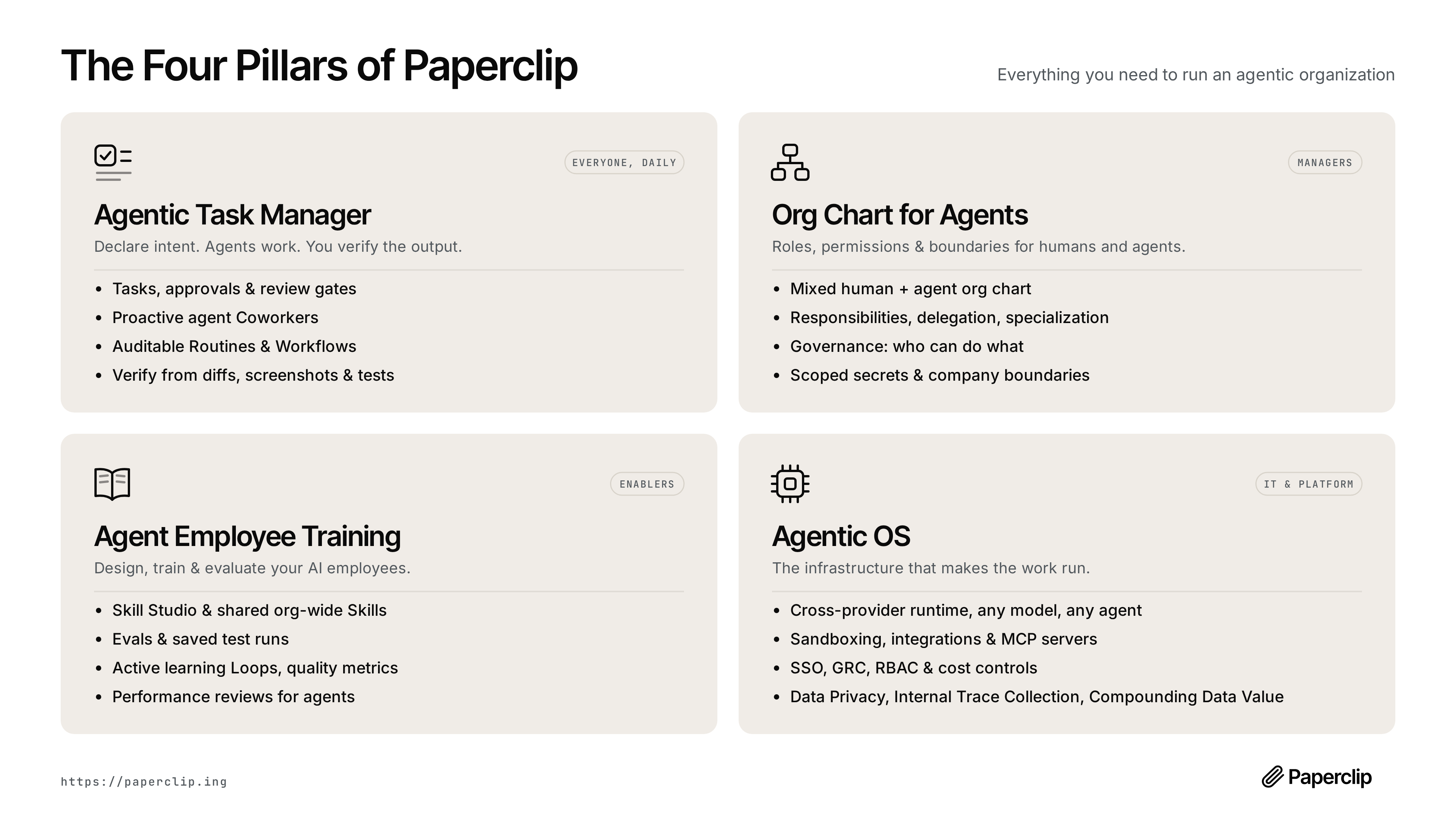
The four pillars of Paperclip
Pillar Built for What it covers
Agentic Task Manager — Declare intent. Agents work. You verify the output. Everyone, daily Tasks, approvals & review gates · proactive agent coworkers · auditable routines & workflows · verify from diffs, screenshots & tests
Org Chart for Agents — Roles, permissions & boundaries for humans and agents. Managers Mixed human + agent org chart · responsibilities, delegation, specialization · governance: who can do what · scoped secrets & company boundaries · connection permissions & responsible-user identities
Agent Employee Training — Design, train & evaluate your AI employees. Enablers Skill Studio & shared org-wide skills · evals & saved test runs · active learning loops & quality metrics · performance reviews for agents · saved test inputs · skill version history & restore · reusable team templates
Agentic OS — The infrastructure that makes the work run. IT & platform Cross-provider runtime: any model, any agent · sandboxing, integrations & MCP servers · SSO, GRC, RBAC & cost controls · data privacy, internal trace collection, compounding data value · personal & shared app connections · run history & opt-in tracing

Features

🔌 Bring Your Own Agent

Any agent, any runtime, one org chart. If it can receive a heartbeat, it's hired.

🎯 Goal Alignment

Link tasks and projects to your organization goals. Agents receive the goal context behind their work.

💓 Heartbeats

Agents wake for assigned work, follow-up messages, or configured schedules. Delegation flows up and down the org chart.

💰 Cost Control

Company, agent, and project budgets. Track reported spend, get threshold alerts, and pause work at configured limits.

🏢 Multi-Organization

One deployment, many organizations. Separate tasks, agents, permissions, and activity histories for each.

🎫 Task Threads

Keep conversations, plans, blockers, files, and run history attached to the work. Assign tasks to agents or people.

🛡️ Governance

Configure review and approval stages, approve hires, and pause, reassign, or stop work when needed.

📊 Org Chart

Hierarchies, roles, reporting lines. Your agents have a boss, a title, and a job description.

📱 Mobile Ready

Monitor and manage your autonomous businesses from anywhere.

🔗 Apps & Connections

Connect services such as GitHub, Notion, and Railway, or your own MCP server. Set gateway actions to Allowed, Ask first, or Off.

👥 Shared Agents, Personal Accounts

Choose who can use a connection and which agents can access it. Managed GitHub operations can use the account of the person directing the work.

🧠 Skills & Skill Studio

Install or write shared skills, test them with saved inputs, inspect results, and restore earlier versions.

📅 Scheduled Routines

Run recurring work on a schedule or trigger it through an API or webhook. Each run has a task, an owner, and a history.

📎 Artifacts & Feedback

Find the files and documents agents produce. Preview supported formats and leave comments on specific passages in documents.

📦 Ready-Made Teams

Preview and install teams with roles, skills, projects, and routines. Choose their runtimes and make the setup your own.

Experimental Agent Chat and chat/email connectors add conversations with agents in Paperclip and through configured services such as Slack, Discord, Telegram, and AgentMail. Enable the relevant instance settings to try them.


Problems Paperclip solves

Without Paperclip With Paperclip
❌ You have 20 Claude Code tabs open and can't track which one does what. On reboot you lose everything. ✅ Tasks are ticket-based, conversations are threaded, sessions persist across reboots.
❌ You manually gather context from several places to remind your bot what you're actually doing. ✅ Context flows from the task up through the project and company goals — your agent always knows what to do and why.
❌ Folders of agent configs are disorganized and you're re-inventing task management, communication, and coordination between agents. ✅ Paperclip gives you org charts, ticketing, delegation, and governance out of the box — so you run a company, not a pile of scripts.
❌ Runaway loops waste hundreds of dollars of tokens and max your quota before you even know what happened. ✅ Spend tracking, budget alerts, and automatic pauses help you control the cost of ongoing work.
❌ You have recurring jobs (customer support, social, reports) and have to remember to manually kick them off. ✅ Routines create assigned tasks on a schedule, with outputs and run history you can inspect.
❌ You have an idea, you have to find your repo, fire up Claude Code, keep a tab open, and babysit it. ✅ Add a task in Paperclip. Your coding agent works on it until it's done. Management reviews their work.

Why Paperclip is special

Paperclip handles the hard orchestration details correctly.

Atomic task checkout. A single assignee and execution locks prevent competing runs from claiming the same task.
Persistent work context. Tasks, comments, and documents stay in Paperclip. Supporting adapters resume saved sessions across runs.
Runtime skill injection. Agents can learn Paperclip workflows and project context at runtime, without retraining.
Governance with rollback. Approval gates are enforced, config changes are revisioned, and bad changes can be rolled back safely.
Accountable connections. Human access, agent eligibility, and gateway action permissions are separate controls. Approve a call once or save a revocable rule.
Goal-aware execution. Linked tasks and projects carry goal ancestry so agents see the "why," not just a title.
Portable company templates. Export/import orgs, agents, and skills with secret scrubbing and collision handling.
Organization boundaries. Company-scoped access checks keep each organization's work, agents, and activity separate within one deployment.

What's Under the Hood

Paperclip is a full control plane, not a wrapper. Before you build any of this yourself, know that it already exists:

┌──────────────────────────────────────────────────────────────┐
│                       PAPERCLIP SERVER                       │
│                                                              │
│  ┌───────────┐  ┌───────────┐  ┌───────────┐  ┌───────────┐  │
│  │Identity & │  │  Work &   │  │ Heartbeat │  │Governance │  │
│  │  Access   │  │   Tasks   │  │ Execution │  │& Approvals│  │
│  └───────────┘  └───────────┘  └───────────┘  └───────────┘  │
│                                                              │
│  ┌───────────┐  ┌───────────┐  ┌───────────┐  ┌───────────┐  │
│  │ Org Chart │  │Workspaces │  │  Plugins  │  │  Budget   │  │
│  │ & Agents  │  │ & Runtime │  │           │  │ & Costs   │  │
│  └───────────┘  └───────────┘  └───────────┘  └───────────┘  │
│                                                              │
│  ┌───────────┐  ┌───────────┐  ┌───────────┐  ┌───────────┐  │
│  │ Routines  │  │ Secrets & │  │ Activity  │  │  Company  │  │
│  │& Schedules│  │  Storage  │  │ & Events  │  │Portability│  │
│  └───────────┘  └───────────┘  └───────────┘  └───────────┘  │
└──────────────────────────────────────────────────────────────┘
         ▲              ▲              ▲              ▲
   ┌─────┴─────┐  ┌─────┴─────┐  ┌─────┴─────┐  ┌─────┴─────┐
   │  Claude   │  │   Codex   │  │   CLI     │  │ HTTP/web  │
   │   Code    │  │           │  │  agents   │  │   bots    │
   └───────────┘  └───────────┘  └───────────┘  └───────────┘

The Systems

Identity & Access — Two deployment modes (trusted local or authenticated), human roles and permissions, agent API keys, short-lived run JWTs, company memberships, and invite flows. Responsible-user attribution follows work through delegation and supported managed connections.

Org Chart & Agents — Agents have roles, titles, reporting lines, permissions, and budgets. Adapter examples match the diagram: Claude Code, Codex, CLI agents such as Cursor/Gemini/bash, HTTP/webhook bots such as OpenClaw, and external adapter plugins. If it can receive a heartbeat, it's hired.

Work & Task System — Issues carry company/project/goal/parent links, atomic checkout with execution locks, first-class blocker dependencies, comments, documents, attachments, work products, labels, and inbox state. Search across work, review document revisions, and leave anchored feedback.

Heartbeat Execution — DB-backed wakeup queue with coalescing, budget checks, workspace resolution, secret injection, skill loading, and adapter invocation. Runs produce logs, usage records, and adapter-specific session state. Bounded recovery handles supported failures and surfaces cases that need human action.

Workspaces & Runtime — Project repositories and workspaces, optional isolated execution workspaces (git worktrees, operator branches), and runtime services (dev servers, preview URLs). Sandbox providers extend execution beyond the local host; availability depends on the configured environment and adapter.

Governance & Approvals — Board approval workflows, execution policies with review/approval stages, decision tracking, budget hard-stops, and agent pause/resume/terminate. Configured task reviews govern completion; connection action approvals govern calls through the tool gateway.

Budget & Cost Control — Token and cost tracking by company, agent, project, goal, issue, provider, and model. Scoped budget policies with warning thresholds and hard stops. Enforcement uses recorded spend; usage reporting and in-flight work can delay a stop.

Routines & Schedules — Recurring tasks with cron, webhook, and API triggers. Concurrency and catch-up policies. Each routine execution creates a tracked issue and wakes the assigned agent — no manual kick-offs needed.

Plugins — Instance-wide plugin system with out-of-process workers, capability-gated host services, job scheduling, tool exposure, and UI contributions. Extend Paperclip without forking it.

Secrets & Storage — Company secrets and per-person secret values, encrypted credential storage, local or S3-compatible file storage, attachments, and work products. Secret references supply credentials to authorized runs without copying values into ordinary agent configuration.

Activity & Events — Mutating actions, heartbeat state changes, cost events, approvals, comments, and work products are recorded as durable activity so operators can audit what happened and why.

Company Portability — Preview, export, and import organization packages with agents, skills, and optional projects, routines, tasks, and attachments. Referenced secret values are omitted; review packages before sharing because plain environment values and local paths can remain. Packages share an operating setup; full-instance recovery uses backups.


What Paperclip is not

Not just a chatbot. Conversations stay attached to tasks, plans, decisions, and outputs. Experimental Agent Chat can hand work off to assigned tasks.
Not an agent framework. We don't tell you how to build agents. We tell you how to run a company made of them.
Not just a workflow builder. Routines and experimental pipelines operate within an organization, with roles, goals, budgets, and governance.
Not a prompt manager. Agents bring their own prompts, models, and runtimes. Paperclip manages the organization they work in.
Not limited to one agent. Start with one agent and grow into a team with shared skills, delegation, and review.
Not only for code review. Coding and PR review fit alongside research, operations, content, and other work.

Quickstart

Open source. Self-hosted. No Paperclip account required. Follow the guided quickstart to set up your first agent.

Just ask your agent to install Paperclip

Share the installation guide with your agent.

Or install it yourself

With Node.js 24.11 or newer installed:

npx paperclipai@latest onboard --yes

The CLI runs from npm's cache; your instance configuration and data persist locally.

See the installation guide for managed installs, pinned versions, canary and git-ref installs, updates, rollback, service management, and uninstalling.

For an isolated manual test instance that is already initialized with a CEO agent, use test-drive. It stays in the foreground, never installs a service or creates a first task, and opens the browser only after setup succeeds:

ANTHROPIC_API_KEY=... npx paperclipai test-drive
OPENAI_API_KEY=... npx paperclipai test-drive --harness codex
OPENROUTER_API_KEY=... npx paperclipai test-drive \
  --harness opencode \
  --model openrouter/anthropic/claude-sonnet-4.5

Each run without --data-dir gets a unique, retained temporary directory; its absolute path is printed at startup. Pass --data-dir to reuse one, or --no-browser to leave the initialized instance unopened. When invoked from a linked Git worktree, test-drive also enables task execution in that worktree. See the test-drive guide for credential and reuse behavior.

Troubleshooting: private npm registry .npmrc

If this fails with an E404 for paperclipai (or similar) and you use a private npm registry (for example GitHub Packages) via a global ~/.npmrc, npx may be resolving paperclipai against that private registry instead of the public npm registry.

Diagnostic:

npm config get registry

Workaround (cross-platform; force the public npm registry for this command):

npx --registry https://registry.npmjs.org paperclipai@latest onboard --yes

That quickstart path now defaults to trusted local loopback mode for the fastest first run. To start in authenticated/private mode instead, choose a bind preset explicitly:

npx paperclipai@latest onboard --yes --bind lan
# or:
npx paperclipai@latest onboard --yes --bind tailnet

If you already have Paperclip configured, rerunning onboard keeps the existing config in place. Use npx paperclipai configure to edit settings.

Or manually:

git clone https://github.com/paperclipai/paperclip.git
cd paperclip
pnpm install
pnpm dev

This starts the UI and API at http://localhost:3100. An embedded PostgreSQL database is created automatically — no setup required.

Requirements: Node.js 24.11+, pnpm 9.15+

Source development also builds the native Paperclip Runner when enabled (the self-hosted default). Install a Rust toolchain, or set PAPERCLIP_RUNNER_BINARY to a compatible prebuilt runner.


FAQ

Q: Is this project maintained or just slop?

A: Paperclip is maintained by the Paperclip team. We've merged over 2,700 pull requests.


Q: What does a typical setup look like?

A: Locally, a single Node.js process manages an embedded Postgres and local file storage. For production, point it at your own Postgres and deploy however you like. Configure projects, agents, and goals — the agents take care of the rest.

For remote access, use authenticated mode with a private-network bind such as Tailscale, or deploy the persistent server with Docker. See deployment modes and the Docker guide.


Q: Can I run multiple companies?

A: Yes. A single deployment can host multiple organizations with company-scoped data and access checks.


Q: How is Paperclip different from agents like OpenClaw or Claude Code?

A: Paperclip uses those agents. It orchestrates them into a company — with org charts, budgets, goals, governance, and accountability.


Q: Why should I use Paperclip instead of just pointing my OpenClaw to Asana or Trello?

A: Agent orchestration has subtleties in how you coordinate who has work checked out, how to maintain sessions, monitoring costs, establishing governance - Paperclip does this for you.

(Bring-your-own-ticket-system is on the Roadmap)


Q: Do agents run continuously?

A: Agents wake for assigned work and follow-up messages. Optional timer heartbeats let them check for work periodically; routines create recurring tasks on their own schedules. You can also connect externally running agents such as OpenClaw. A mention alone does not assign work or wake another agent.


Development

pnpm dev              # Full dev (API + UI, watch mode)
pnpm dev:once         # Full dev without file watching
pnpm dev:server       # Server only
pnpm dev:mobile       # Serve prebuilt UI on :3101 for phones/tablets (proxies /api → :3100)
pnpm dev:both         # Run `pnpm dev` and `pnpm dev:mobile` together
pnpm build            # Build all
pnpm typecheck        # Type checking
pnpm test             # Cheap default test run (Vitest only)
pnpm test:watch       # Vitest watch mode
pnpm test:e2e         # Playwright browser suite
pnpm db:generate      # Generate DB migration
pnpm db:migrate       # Apply migrations

pnpm test does not run Playwright. Browser suites stay separate and are typically run only when working on those flows or in CI.

See doc/DEVELOPING.md for the full development guide.


Roadmap

  • ✅ Plugin system (e.g. add a knowledge base, custom tracing, queues, etc)
  • ✅ Get OpenClaw / claw-style agent employees
  • ✅ companies.sh - import and export entire organizations
  • ✅ Easy AGENTS.md configurations
  • ✅ Skills Manager, Skill Studio & Skills Store
  • ✅ Scheduled Routines
  • ✅ Better Budgeting
  • ✅ Agent Reviews and Approvals
  • ✅ Multiple Human Users
  • ✅ Cloud / Sandbox agents (e2b, Cloudflare, Daytona, Modal, Novita, self-hosted Kubernetes)
  • ✅ Artifacts & Work Products
  • ✅ Deep Planning (planning mode, revisioned plans, plan approvals)
  • ✅ Enforced Outcomes (watchdogs, recovery actions, review gates)
  • ✅ MCP Tool Gateway & Apps (governed tool access)
  • ✅ Secrets Manager with per-agent access
  • ✅ Activity log & action attribution
  • ✅ Self-healing runs & automatic recovery
  • ✅ Agent evals & feedback
  • ✅ Connected Apps
  • ✅ Personal & Shared AI Accounts
  • ✅ Shared Agents Use Personal GitHub Identities
  • ✅ Skill Version History & Restore
  • ✅ Document Comments & Revision History
  • ✅ Company-Wide Search
  • ✅ Multi-Model & Multi-Harness Teams
  • 🟡 Memory / Knowledge
  • ⚪ MAXIMIZER MODE
  • ⚪ Work Queues
  • ⚪ Self-Organization
  • ⚪ Automatic Organizational Learning
  • 🟡 Agent Chat
  • 🟡 Cloud deployments
  • ⚪ Desktop App
  • ⚪ Bring-your-own-ticket-system (Asana / Linear / Jira as on-ramps)

This is the short roadmap preview. See the full roadmap in ROADMAP.md.


Community & Plugins

Find Plugins and more at awesome-paperclip

Observability

Paperclip ships with opt-in OpenTelemetry auto-instrumentation for the server (traces only). It activates when OTEL_EXPORTER_OTLP_ENDPOINT is set and supports grpc, http/protobuf, and http/json via the standard OTEL_EXPORTER_OTLP_PROTOCOL env var. @opentelemetry/api is a normal server dependency; the SDK, auto-instrumentation, and exporter packages are optional peer dependencies — install them only if you want tracing. See doc/observability.md for install commands and the full env-var reference.

Paperclip also ships with opt-in Sentry error monitoring for the server and the browser. Set SENTRY_DSN_FRONTEND to activate it for the browser and SENTRY_DSN_BACKEND to activate it for the server — each variable is optional, and the legacy SENTRY_DSN variable still works as a fallback for either component. The supported server SDK version is @sentry/[email protected]; it is an optional peer dependency for the server, so install it only if you want error monitoring. The browser SDK, @sentry/browser, is pinned to the same exact version. See doc/observability.md for the install command, the privacy settings, and the full default capture set.

Telemetry

Paperclip collects anonymous usage telemetry to help us understand how the product is used and improve it. No personal information, issue content, prompts, file paths, or secrets are ever collected. Private repository references are hashed with a per-install salt before being sent.

Contributors changing emitted telemetry events should follow the Telemetry Data Contract. For proposed first-party events that are not in the generated contract yet, follow Telemetry Workflow.

Telemetry is enabled by default and can be disabled with any of the following:

Method How
Environment variable PAPERCLIP_TELEMETRY_DISABLED=1
Standard convention DO_NOT_TRACK=1
CI environments Automatically disabled when CI=true
Config file Set telemetry.enabled: false in your Paperclip config

Contributing

We welcome contributions. See the contributing guide for details.

We're hiring


Community


License

MIT © 2026 Paperclip Labs, Inc

Star History

Star History Chart

Open source under MIT. Built for people who want to get work done, not babysit agents.

View on GitHub

Recent activity

commits and pull requests

Releases and announcements

27 total
  1. v2026.1001.0v2026.1001.0Oct 2, 202612 downloads

    # Paperclip v2026.1001.0 > Released: 2026-10-01 Paperclip v2026.1001.0 carries 77 commits, promoted from `2026.921.0-beta.1`. The headline is reliability: a deep hardening pass over the native runner and chat recovery — approval and Stop races, session continuity, sandbox reconnection and cleanup — alongside a friendlier face: agent personas throughout the app, an animated onboarding character, and a rebuilt Slack setup. Around those: agents can review GitHub pull requests as scheduled review bots, Railway joins the connector catalog with governed deployment tools, approvals and answers queue during active runs instead of bouncing, and execution harnesses now default to full auto. ## Breaking Changes - **The legacy Composio broker is retired.** The API-key catalog method, broker clients, session creation, account synchronization, child lifecycle and toolkit routes, and the Services tab are all removed. Existing legacy Composio connections stop working, and there is no automated migration — the experimental MCP aggregator connectors (below) are the successor path; see the Upgrade Guide for the manual steps. Vercel provenance is untouched. ([#13758](https://github.com/paperclipai

  2. v2026.916.1v2026.916.1Sep 21, 2026597 downloads

    # Paperclip v2026.916.1 > Released: 2026-09-21 A patch on top of [2026.916.0](https://github.com/paperclipai/paperclip/releases/tag/v2026.916.0) that fixes sending messages in the task conversation view. It carries one targeted fix (plus its regression tests and a small server error-classification repair that rode along in the same commit); everything else in 2026.916.0 is unchanged. ## Fixes - **The chat composer's send button no longer starts out disabled on desktop.** The task page disables the composer while it checks whether the task is paused, and in React Query v5 that pending state is true from mount until the first *successful* response — so every desktop task page loaded with the send button disabled, and it stayed disabled for good if the pause-status request stalled. Sends are now allowed while the check is pending: the server remains authoritative and rejects messages to paused tasks with a 409 before saving a comment or waking an agent, and a confirmed pause hold or a failed status check still blocks the composer as before. ([#13562](https://github.com/paperclipai/paperclip/pull/13562)) - **Duplicate document inserts wrapped by the ORM are classified as retryable

  3. v2026.916.0v2026.916.0Sep 16, 202639 downloads

    # Paperclip v2026.916.0 > Released: 2026-09-16 Paperclip v2026.916.0 carries 503 commits, promoted from `2026.916.0-beta.0` published the same day. The headline is the Connections train: AI runtime credentials — Claude and Codex subscriptions, API keys, shared accounts — now live in Connections under the same grants and permission boundaries as every other account, follow the responsible person through hiring and task execution, and can be connected or repaired inline from the task that needs them. Around it: agents get their own email addresses through AgentMail, experimental chat connectors bring Slack, Discord, Telegram, Microsoft Teams, and (via Photon) iMessage conversations into tasks, GitHub access becomes durable per-person identities instead of one shared token, announcements arrive as native in-app cards, and the experimental Paperclip Runner grew from last release's groundwork into a complete execution engine — with the gate now open by default on self-hosted installs for explicitly configured agents. ## Breaking Changes - **Cheap model profiles are removed.** The second execution mode that let recovery and overrides run on a cheaper model is gone from adapter metada

  4. v2026.831.1v2026.831.1Sep 2, 202677 downloads

    # Paperclip v2026.831.1 > Released: 2026-09-02 A patch on top of [2026.831.0](https://github.com/paperclipai/paperclip/releases/tag/v2026.831.0) that fixes first-run onboarding. It carries a single targeted change; everything else in 2026.831.0 is unchanged. ## Fixes - **Onboarding no longer gets stuck on the organization step.** On the first onboarding screen ("What is the name of your organization?"), clicking **Continue** created the organization on the server but could leave the wizard sitting on the same step — so the page appeared to just refresh, and repeated clicks silently created duplicate organizations. The company-created list refresh can make the surrounding app adopt the just-created organization before the create request's continuation runs; the wizard now recognizes that as the same successful transition and advances to the first-agent step, while a genuine switch to a different organization still stops with a clear message. ([#12667](https://github.com/paperclipai/paperclip/pull/12667)) ## Upgrade Guide - No migrations, no configuration changes, no API changes. Upgrade in place.

  5. v2026.831.0v2026.831.0Sep 2, 202618 downloads

    # Paperclip v2026.831.0 > Released: 2026-08-31 Paperclip v2026.831.0 soaked as `2026.828.0-beta.0` and carries 175 commits. The company skill library now actually reaches your agents at run time, Kimi Code joins the adapter lineup, operators hosting Paperclip for others get real control over which settings surfaces their users see, the sandbox callback bridge is rebuilt on a bounded HTTP/2 transport, and onboarding sheds its mission step for a shorter arc with the agent front and center. It also raises the Node.js floor to 24 — read the Upgrade Guide before updating a source install. ## Breaking Changes - **Node.js 24.11.0 or newer is required.** Every package manifest declares the new floor and the Docker images ship Node 24. Only managed installs (`paperclipai install`) refuse outright on an older Node; npm installs and a directly started server on Node 22/23 print an unsupported-version warning and continue. A warning is not support — upgrade Node before taking this release. ([#11792](https://github.com/paperclipai/paperclip/pull/11792), [#11890](https://github.com/paperclipai/paperclip/pull/11890)) - **Invalid agent credentials are rejected instead of downgraded.** A bearer

Code frequency

additions and deletions
+3.7M-3.7MWeek of 2026-02-15: +117,093 linesWeek of 2026-02-15: -13,918 linesWeek of 2026-02-22: +61,825 linesWeek of 2026-02-22: -4,182 linesWeek of 2026-03-01: +74,035 linesWeek of 2026-03-01: -18,472 linesWeek of 2026-03-08: +180,559 linesWeek of 2026-03-08: -35,209 linesWeek of 2026-03-15: +161,152 linesWeek of 2026-03-15: -14,848 linesWeek of 2026-03-22: +74,740 linesWeek of 2026-03-22: -12,951 linesWeek of 2026-03-29: +68,701 linesWeek of 2026-03-29: -4,050 linesWeek of 2026-04-05: +107,827 linesWeek of 2026-04-05: -10,541 linesWeek of 2026-04-12: +61,096 linesWeek of 2026-04-12: -4,478 linesWeek of 2026-04-19: +138,559 linesWeek of 2026-04-19: -9,135 linesWeek of 2026-04-26: +82,790 linesWeek of 2026-04-26: -2,985 linesWeek of 2026-05-03: +151,169 linesWeek of 2026-05-03: -21,365 linesWeek of 2026-05-10: +52,652 linesWeek of 2026-05-10: -4,798 linesWeek of 2026-05-17: +32,538 linesWeek of 2026-05-17: -1,719 linesWeek of 2026-05-24: +105,920 linesWeek of 2026-05-24: -1,418 linesWeek of 2026-05-31: +125,162 linesWeek of 2026-05-31: -5,034 linesWeek of 2026-06-07: +70,614 linesWeek of 2026-06-07: -24,246 linesWeek of 2026-06-14: +28,907 linesWeek of 2026-06-14: -6,534 linesWeek of 2026-06-21: +93,399 linesWeek of 2026-06-21: -14,643 linesWeek of 2026-06-28: +41,841 linesWeek of 2026-06-28: -10,331 linesWeek of 2026-07-05: +133,639 linesWeek of 2026-07-05: -16,119 linesWeek of 2026-07-12: +142,758 linesWeek of 2026-07-12: -5,003 linesWeek of 2026-07-19: +44,035 linesWeek of 2026-07-19: -4,160 linesWeek of 2026-07-26: +189,581 linesWeek of 2026-07-26: -10,884 linesWeek of 2026-08-02: +339,996 linesWeek of 2026-08-02: -14,588 linesWeek of 2026-08-09: +219,579 linesWeek of 2026-08-09: -8,570 linesWeek of 2026-08-16: +370,969 linesWeek of 2026-08-16: -16,172 linesWeek of 2026-08-23: +491,487 linesWeek of 2026-08-23: -48,376 linesWeek of 2026-08-30: +718,602 linesWeek of 2026-08-30: -49,453 linesWeek of 2026-09-06: +2,236,831 linesWeek of 2026-09-06: -66,069 linesWeek of 2026-09-13: +266,510 linesWeek of 2026-09-13: -3,694,122 linesWeek of 2026-09-20: +139,943 linesWeek of 2026-09-20: -103,348 linesFeb 15, 2026Sep 20, 2026
+7.1M lines added, -4.3M removed over the last year.

Commits per week

last 52 weeks
3840Week of 2025-10-04: 0 commitsWeek of 2025-10-11: 0 commitsWeek of 2025-10-18: 0 commitsWeek of 2025-10-25: 0 commitsWeek of 2025-11-01: 0 commitsWeek of 2025-11-09: 0 commitsWeek of 2025-11-16: 0 commitsWeek of 2025-11-23: 0 commitsWeek of 2025-11-30: 0 commitsWeek of 2025-12-07: 0 commitsWeek of 2025-12-14: 0 commitsWeek of 2025-12-21: 0 commitsWeek of 2025-12-28: 0 commitsWeek of 2026-01-04: 0 commitsWeek of 2026-01-11: 0 commitsWeek of 2026-01-18: 0 commitsWeek of 2026-01-25: 0 commitsWeek of 2026-02-01: 0 commitsWeek of 2026-02-08: 0 commitsWeek of 2026-02-15: 150 commitsWeek of 2026-02-22: 81 commitsWeek of 2026-03-01: 384 commitsWeek of 2026-03-08: 307 commitsWeek of 2026-03-15: 335 commitsWeek of 2026-03-22: 207 commitsWeek of 2026-03-29: 165 commitsWeek of 2026-04-05: 234 commitsWeek of 2026-04-12: 33 commitsWeek of 2026-04-19: 53 commitsWeek of 2026-04-26: 58 commitsWeek of 2026-05-03: 59 commitsWeek of 2026-05-10: 46 commitsWeek of 2026-05-17: 33 commitsWeek of 2026-05-24: 26 commitsWeek of 2026-05-31: 95 commitsWeek of 2026-06-07: 73 commitsWeek of 2026-06-14: 81 commitsWeek of 2026-06-21: 64 commitsWeek of 2026-06-28: 54 commitsWeek of 2026-07-05: 128 commitsWeek of 2026-07-12: 104 commitsWeek of 2026-07-19: 113 commitsWeek of 2026-07-26: 140 commitsWeek of 2026-08-02: 110 commitsWeek of 2026-08-09: 138 commitsWeek of 2026-08-16: 146 commitsWeek of 2026-08-23: 192 commitsWeek of 2026-08-30: 216 commitsWeek of 2026-09-06: 180 commitsWeek of 2026-09-13: 105 commitsWeek of 2026-09-20: 104 commitsWeek of 2026-09-27: 131 commitsOct 4, 2025Sep 27, 2026
4.3K commits in the last 52 weeks.

When work happens

weekday and hour
SunMonTueWedThuFriSat036912151821Sun 0:00 — 9 commitsSun 1:00 — 5 commitsSun 2:00 — 0 commitsSun 3:00 — 5 commitsSun 4:00 — 0 commitsSun 5:00 — 3 commitsSun 6:00 — 18 commitsSun 7:00 — 12 commitsSun 8:00 — 9 commitsSun 9:00 — 7 commitsSun 10:00 — 17 commitsSun 11:00 — 10 commitsSun 12:00 — 11 commitsSun 13:00 — 12 commitsSun 14:00 — 14 commitsSun 15:00 — 10 commitsSun 16:00 — 12 commitsSun 17:00 — 15 commitsSun 18:00 — 13 commitsSun 19:00 — 12 commitsSun 20:00 — 18 commitsSun 21:00 — 18 commitsSun 22:00 — 9 commitsSun 23:00 — 2 commitsMon 0:00 — 11 commitsMon 1:00 — 4 commitsMon 2:00 — 5 commitsMon 3:00 — 2 commitsMon 4:00 — 1 commitsMon 5:00 — 2 commitsMon 6:00 — 18 commitsMon 7:00 — 24 commitsMon 8:00 — 60 commitsMon 9:00 — 61 commitsMon 10:00 — 59 commitsMon 11:00 — 29 commitsMon 12:00 — 30 commitsMon 13:00 — 45 commitsMon 14:00 — 39 commitsMon 15:00 — 35 commitsMon 16:00 — 77 commitsMon 17:00 — 38 commitsMon 18:00 — 20 commitsMon 19:00 — 53 commitsMon 20:00 — 53 commitsMon 21:00 — 41 commitsMon 22:00 — 22 commitsMon 23:00 — 12 commitsTue 0:00 — 5 commitsTue 1:00 — 12 commitsTue 2:00 — 3 commitsTue 3:00 — 1 commitsTue 4:00 — 3 commitsTue 5:00 — 7 commitsTue 6:00 — 8 commitsTue 7:00 — 22 commitsTue 8:00 — 47 commitsTue 9:00 — 76 commitsTue 10:00 — 87 commitsTue 11:00 — 44 commitsTue 12:00 — 63 commitsTue 13:00 — 54 commitsTue 14:00 — 44 commitsTue 15:00 — 58 commitsTue 16:00 — 54 commitsTue 17:00 — 34 commitsTue 18:00 — 14 commitsTue 19:00 — 22 commitsTue 20:00 — 28 commitsTue 21:00 — 20 commitsTue 22:00 — 11 commitsTue 23:00 — 14 commitsWed 0:00 — 13 commitsWed 1:00 — 1 commitsWed 2:00 — 4 commitsWed 3:00 — 0 commitsWed 4:00 — 0 commitsWed 5:00 — 1 commitsWed 6:00 — 19 commitsWed 7:00 — 32 commitsWed 8:00 — 44 commitsWed 9:00 — 34 commitsWed 10:00 — 45 commitsWed 11:00 — 40 commitsWed 12:00 — 26 commitsWed 13:00 — 42 commitsWed 14:00 — 43 commitsWed 15:00 — 38 commitsWed 16:00 — 57 commitsWed 17:00 — 41 commitsWed 18:00 — 20 commitsWed 19:00 — 18 commitsWed 20:00 — 30 commitsWed 21:00 — 49 commitsWed 22:00 — 14 commitsWed 23:00 — 28 commitsThu 0:00 — 12 commitsThu 1:00 — 15 commitsThu 2:00 — 9 commitsThu 3:00 — 3 commitsThu 4:00 — 3 commitsThu 5:00 — 3 commitsThu 6:00 — 25 commitsThu 7:00 — 46 commitsThu 8:00 — 49 commitsThu 9:00 — 39 commitsThu 10:00 — 56 commitsThu 11:00 — 61 commitsThu 12:00 — 58 commitsThu 13:00 — 44 commitsThu 14:00 — 53 commitsThu 15:00 — 68 commitsThu 16:00 — 70 commitsThu 17:00 — 45 commitsThu 18:00 — 22 commitsThu 19:00 — 21 commitsThu 20:00 — 20 commitsThu 21:00 — 29 commitsThu 22:00 — 26 commitsThu 23:00 — 16 commitsFri 0:00 — 13 commitsFri 1:00 — 5 commitsFri 2:00 — 7 commitsFri 3:00 — 6 commitsFri 4:00 — 0 commitsFri 5:00 — 4 commitsFri 6:00 — 20 commitsFri 7:00 — 46 commitsFri 8:00 — 59 commitsFri 9:00 — 42 commitsFri 10:00 — 47 commitsFri 11:00 — 55 commitsFri 12:00 — 36 commitsFri 13:00 — 54 commitsFri 14:00 — 61 commitsFri 15:00 — 56 commitsFri 16:00 — 49 commitsFri 17:00 — 36 commitsFri 18:00 — 31 commitsFri 19:00 — 23 commitsFri 20:00 — 15 commitsFri 21:00 — 20 commitsFri 22:00 — 31 commitsFri 23:00 — 18 commitsSat 0:00 — 8 commitsSat 1:00 — 12 commitsSat 2:00 — 9 commitsSat 3:00 — 10 commitsSat 4:00 — 1 commitsSat 5:00 — 1 commitsSat 6:00 — 14 commitsSat 7:00 — 20 commitsSat 8:00 — 38 commitsSat 9:00 — 34 commitsSat 10:00 — 36 commitsSat 11:00 — 32 commitsSat 12:00 — 28 commitsSat 13:00 — 24 commitsSat 14:00 — 21 commitsSat 15:00 — 24 commitsSat 16:00 — 34 commitsSat 17:00 — 28 commitsSat 18:00 — 13 commitsSat 19:00 — 26 commitsSat 20:00 — 21 commitsSat 21:00 — 14 commitsSat 22:00 — 13 commitsSat 23:00 — 11 commits
Commit volume by weekday and hour (UTC). Larger dots mean more commits.
DateListRankStars gained
Oct 4, 2026weekly#1+10,722
Oct 3, 2026weekly#1+12,825
Oct 2, 2026weekly#1+14,335
Oct 1, 2026weekly#1+13,855
Sep 30, 2026daily#4+2,412
Sep 30, 2026weekly#1+12,941
Sep 29, 2026daily#4+2,412
Sep 28, 2026daily#2+3,185
Sep 27, 2026daily#1+2,527
Sep 26, 2026daily#1+2,109
Sep 25, 2026daily#1+1,853
Aug 18, 2026weekly#12+2,499
Aug 17, 2026weekly#12+2,499
Aug 16, 2026weekly#13+2,430
Aug 14, 2026daily#7+571
  • freeCodeCamp/freeCodeCamp

    freeCodeCamp.org's open-source codebase and curriculum. Learn math, programming, and computer science for free.

    456.7K stars · TypeScript

  • openclaw/openclaw

    The AI that really does things. Any OS. Any Platform. The lobster way. 🦞

    391.3K stars · TypeScript

  • anomalyco/opencode

    The open source coding agent.

    211.7K stars · TypeScript

  • n8n-io/n8n

    Fair-code workflow automation platform with native AI capabilities. Combine visual building with custom code, self-host or cloud, 400+ integrations.

    206.7K stars · TypeScript

  • microsoft/vscode

    Visual Studio Code

    193.5K stars · TypeScript

  • firecrawl/firecrawl

    Supercharge your AI agents with data from the web and beyond. Building the library for superintelligence. 🔥

    188.6K stars · TypeScript